Chilies, Code-Breaking, and a Childhood Love that Refuses to Die: Kase Johnstun's Let the Wild Grasses Grow
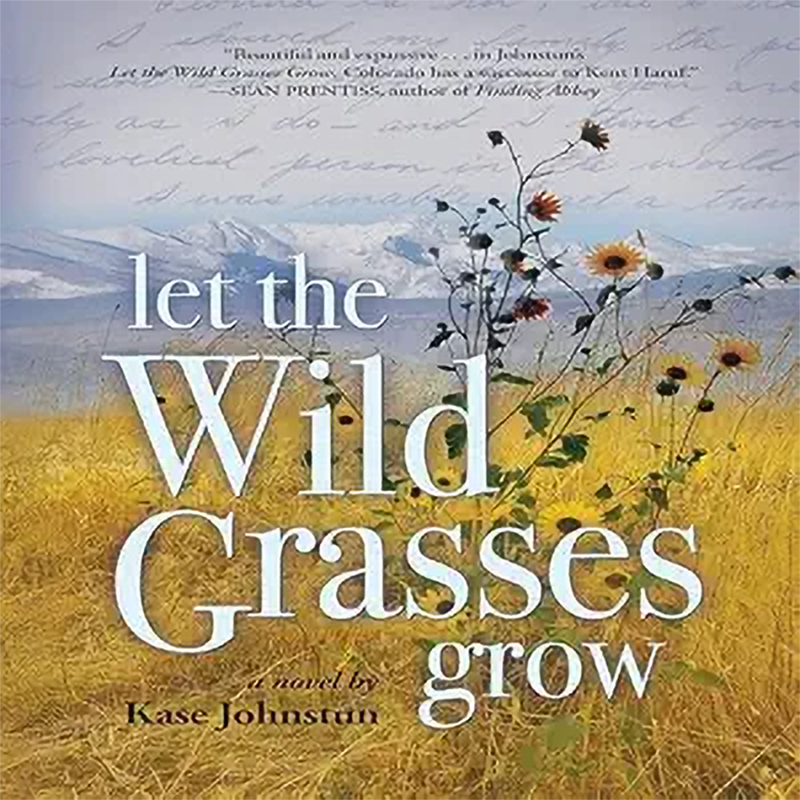
A grandfather's chili patch. A grandmother who made it to third grade and was, by everyone's account, the wittiest person in the room. A submarine crew that never knew the women breaking codes back home were protecting them. These are the threads Kase weaves into Let the Wild Grasses Grow, a novel that began, of all places, with an essay about Kase helping his grandpa grow chiles as a kid in Uintah, Utah.
What started as a tribute to two grandparents Kase knew only as old people became something much larger: an imagined answer to the question of what their lives might have been like decades earlier, as Mexican-Americans coming of age in southern Colorado during the Dust Bowl, the Depression, and World War II.
The novel doesn't flinch from the ugliness of that period. One scene built from a real 1929 photograph of a Klan-hosted parade in Trinidad, Colorado, stopped me cold, as did a moment I can’t describe here when Kase pulls the rug out. But the book never loses its warmth, its humor, or its deep affection for the people at its center.
Della and John are invented answers to real questions. What if Grandma had gotten the education she never had access to? What if she'd served as a code-breaker, and had to carry that secret the way so many real codebreakers did, some to their graves? What if Grandpa had been allowed to step out of his role as cook? Kase builds these possibilities on a foundation of research and family memory, and the result is a book that feels both historically grounded and quietly personal.
I loved talking with Kase about the writing of this book: the chili patch that started it all, his commitment to books with strong women protagonists, and the hard choices that shaped the novel into its final form.
Let the Wild Grasses Grow is available from Torrey House Press
Meet the Author
A Conversation with Kase Johnstun
This interview has been edited for clarity and length.
The Chili Garden
Amanda: Let's start with the chilies. Why so many, and why do they matter so much to the book?
Kase: That question always feels like the right place to start, because it's really where the whole book started. I wrote an essay a few years ago called "Ditch Days," about growing up in Uintah Utah, three houses from my grandparents, Grandpa Cordova and Grandma Cordova Chavez. In the Mexican-American tradition the women keep their maiden name a generation longer, so she kept Chavez.
The book’s protagonists, Della Chavez and John Cordova, are based on my grandparents. My grandpa had this famous chili patch, along with tomatoes and corn, and I used to help him run water from the main ditch down into the little channels that fed his plants. He called them his baby chilies. Everything from that garden went straight to my grandma's kitchen and came back out as salsa.
They'd both passed by the time I was writing that essay, and it got me wondering what their lives were actually like before I knew them; in the 1920s and 30s, in southern Colorado, near Trinidad, at the base of the Sangre de Cristo Mountains. I knew them only as old people. So the book grew out of wondering what it was like for two Mexican-American kids living through the Dust Bowl, the Depression, and World War II. It sprang from chilies, essentially, and it still means everything to me because chilies mean everything to my family.
Amanda: So what actually brought your family to Colorado?
Kase: That's the deeper story the book is trying to hold onto. My family has been in this country, in one form or another, for about 500 years; there are Indigenous roots, then the Spanish-mestizo-Indigenous mixing about 400 years ago. We were part of Mexico almost as long as we've been part of the United States. My grandma used to say, "We didn't jump the border, the border jumped us." It's a complicated, even problematic line by today's standards, but for her it was a way of claiming rights and identity in a world that didn't want to grant her either.
My grandpa lived through being called slurs his whole life. He'd say something like that out of one side of his mouth and then just walk around as the most confident, funny person you ever met. I don't know exactly how it was sixty years earlier, but I know race was always present, always named, even if it was mostly deflected with humor rather than confrontation.
Finding Della and John
Amanda: Does that history show up in Della?
Kase: Della is a "what if." My grandma only made it to third grade and had her first child at 14. She was the smartest person I knew. I was the first on her side to go to college. She called me a "smart little shit" when I got my degree. The book asks what might have happened if she'd had the chance at an education, at something beyond what her circumstances allowed. My grandpa did serve, so that part is real, but Della's path is imagined space for a woman who didn’t have some opportunities.
Betina, the older, saltier character in the book, is my grandmother almost exactly as I knew her: feisty, foul-mouthed, unstoppable. Della is more of an invention, but she's built from the same material.
Amanda: How about John? Was your grandpa really on a submarine?
Kase: My grandpa was a cook in the military during World War II; he was never allowed to be anything else. My dad, though, actually served on a submarine in Vietnam, and it's his stories, plus a lot of research into WWII submarine training (I watched old Navy training films, dug into escape tunnels and diving apparatus) that became John's storyline. So John is really a merging of two generations of the men in my family. Once I researched it, I realized my grandfather could not got any role beyond cook because of the racism in the military.
Research and Surprising Moments
Amanda: I found the KKK scene gripping and surprising.
Kase: That came out of nowhere. I was googling Trinidad, Colorado, in 1929, trying to nail down some period detail, and I found photographs of a Confederacy reunion parade there, hosted, as it turned out, by the KKK. The governor of Colorado at one point was also the grandmaster of the Colorado Klan. I had no idea Colorado had been such a hub. It hit me that my grandparents were living in that world, cruising around a place with almost no Black residents but plenty of organized racism aimed at anyone who wasn't white. I built the whole scene around a real photo. And then my protagonists went into town for seed.
I found the same kind of surprise researching Della's code-breaking work; in a nonfiction book called Code Girls by Liza Mundy, which chronicles the Ivy League women recruited for wartime codebreaking who then went home, got married, and were bound by gag orders that in some cases lasted until 1995. Some of those women died without ever being able to tell anyone what they'd done. Originally I wrote an ending where Della and John are in their eighties and she finally reveals it to him. That ending didn't survive the edit, but it's where I started.
Language and Identity
Amanda: I loved how the Spanglish worked. A reader with no Spanish can follow it, and a bilingual reader gets an insider's layer.
Kase: That was important to me. My grandparents genuinely code-switched between Spanish and English at home, at least until my great-grandparents decided there would be "no more Spanish in the house" after my grandmother and her brother flunked kindergarten. Both generations grew up managing that erasure to avoid being othered for the language itself.
I studied Spanish in college and abroad partly because I worry my generation may be the last to really hold onto it; most of my cousins are drifting away from it, and I don't blame them. But language, food, and the chili patch are just as central to who I am as a person as they are to me as a writer.
Craft
Amanda: The book has two protagonists and is written in alternating points of view. Where does that come from?
Kase: Honestly, I don't think I know how to do it any other way. Every book I've written has two points of view, and I've never finished one with a man as the sole lead. The second I write a strong woman, she takes over. I come from a very matriarchal family, so that probably tracks.
For this book, I wrote in spurts: ten thousand words of John, then ten thousand of Della, then went back and wove them together to see where they intersected. My most recent manuscript I wrote straight through instead, part one from one character, part two from the other.
Amanda: Has a character ever taken over the book?
Kase: Not really, but in every book there's a character who shows up out of nowhere and just sticks around, leaves a mark. In this one that was Helen. She was one of my favorites to write.
Writing Practice
Amanda: What's your writing routine?
Kase: If I can manage it, I'm up at 5 a.m. with coffee while the house is quiet. I get about 45 minutes before I have to answer my first work email, and once I do that, the creative gear is gone for the day. In that window I can usually get down 1,200 words. When I'm rolling on a novel I try not to skip days, and I've learned to stop mid-scene on purpose, even mid-sentence, if things are going well; it's much easier to pick back up than to face a blank page the next morning.
I don't use beta readers or a critique group. I have an agent who will tell me the truth regardless, and with a full-time job and a family, I don't have time to wait on outside feedback.
What's Next
Amanda: What are you working on now?
Kase: I just signed a three-book novel deal with Roan and Weatherford, plus an essay collection with an undisclosed press that digs further into identity, including something I only recently discovered: I'm a direct descendant, several generations back, of a Mormon polygamist's sixth wife, on my father's side, which I know almost nothing about otherwise. That collection will work as a companion piece to both Let the Wild Grasses Grow and my 2024 novel, Castaway. I did write something close to a memoir back in 2015, but these essays are even more memoiristic. I'm calling this new book a memoir in essays.
Torrey House Press
Amanda: How much did the book change in revision?
Kase: A lot. I gave my agent the manuscript after nine months, and we cut 70 percent of that first draft. The second round cut another 40 percent while adding new material. Originally the whole book was framed around a fictionalized version of me as a kid, going to my grandfather's funeral, with him narrating the story to me in flashback, and with a jumping timeline. My agent cut all of that and told me to just tell the story straight through, chronologically. She was right.
Amanda: How has Torrey House been as a publisher?
Kase: Really good. They handle everything from acquisitions through ongoing promotion, which is the advantage of a smaller press: you stay on their radar. One point of contention was that they initially wanted to italicize the Spanish in the book; I pushed back, because italicizing makes it "other." They came around, and I think it was the right call.
The book came out in 2021, right into COVID, so the launch was disrupted, but it's kept selling for five years now, which still surprises me. I launched it, as I do all my books, at my old Catholic high school in Ogden; it's a tight community and it felt right to bring it back there