Fit Into Me A Novel: A Memoir
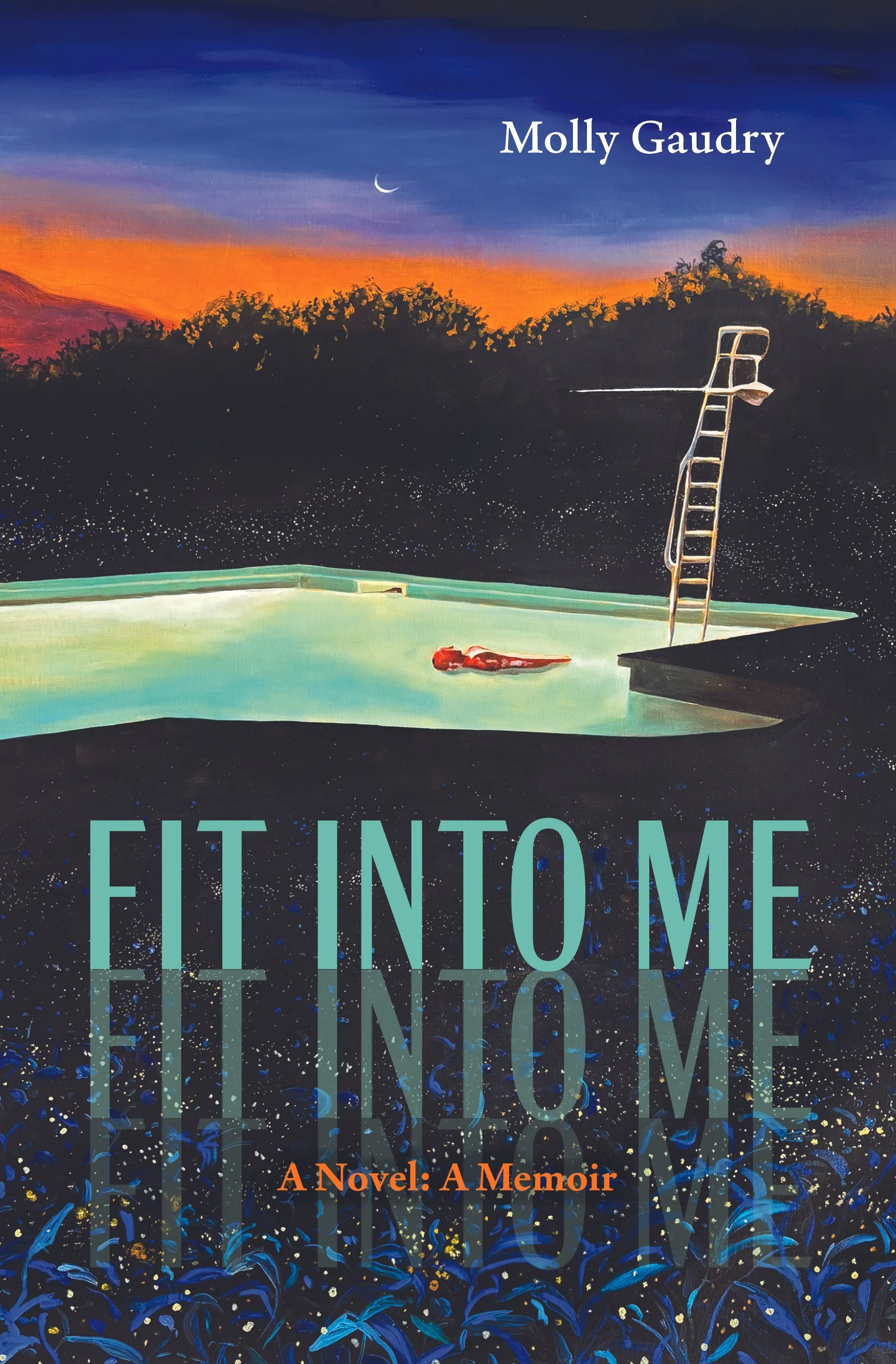
The cover of Fit Into Me
I first encountered Molly Gaudry's work during my MFA at the University of Utah, where she was one of those PhD students whose prose made me feel both inspired and outclassed. She was brilliant and a little daunting and, when she read her work in class, her luscious prose made me want to set down my own scribbles and stare at the ceiling for a while. Later, I got to know her as an incredibly generous classmate, willing to read and gently critique my scrambling prose. When Fit Into Me: A Novel: A Memoir arrived from Rose Metal Press this past December, I came to it with a mixture of anticipation and humility.
The book did not disappoint.
Fit Into Me defies summary. At its most basic, the work simultaneously carries two narratives: a fictional story following the tea house woman — a character I recognized from our early days when Gaudry was writing her second verse novel, Desire: A Haunting — and a series of personal essays in which Gaudry reckons with the most unsettling years of her life. The two tracks run parallel, then braid, then blur, as the book keeps asking whether fiction reveals truth more clearly, and more truly, than nonfiction.
Here, the tea house woman, a bride in Gaudry’s earlier work, is now a widow navigating a difficult lover, her dying father, and the family business she inherited but did not choose. Her story unfolds across the winter holidays in Salt Lake City and, if you went to school there, you may find yourself smiling in recognition at certain streets, certain light, and certain habits of snow.
Next to this fictional winter, Gaudry lays her own: the years during which a skating accident left her with a traumatic brain injury that robbed her, temporarily, of her ability to read and write. She became a writer who could not read. The irony is devastating, and she handles it with a grace that makes you trust her completely.
There's also the matter of adoption. Gaudry, a transnational adoptee raised in an American family, brings her biological origins into the book through one of its most formally daring choices: a speculative essay in which she imagines her Korean half-brother arriving at her door with news of their father's death. It didn't happen. But it reveals something true about longing, about the stories we construct to make sense of our origins, and about how speculation can be its own form of honesty.
This is speculative nonfiction; a genre that deserves a moment of explanation, because it's using something more rigorous than creative license. Speculative nonfiction doesn't blur the line between truth and invention; it insists on the line while also insisting that imagination can serve as a legitimate tool of inquiry. The narrator is always firmly grounded in her own body, her own known reality. It's her mind that travels. What Gaudry imagines about her brother's arrival doesn't claim to be true, but it illuminates the texture of longing and the weight of absence more richly than any bare factual account.
I recognize something in this. I've thought about writing on the death of my mother's first child; a loss that happened before I existed, that I never witnessed, and yet that shadowed my entire childhood. I think her grief over that ungrieved loss shaped mom in ways I have only begun to imagine. I became her oldest child that day, in absentia. Speculative nonfiction might be the only form that can hold that kind of inherited loss; events we know shaped us, but that we can neither claim nor quite release.
What makes all of this cohere is Gaudry's method. She builds her fiction from word banks: lists drawn from writers like Sappho, Nathaniel Hawthorne, Marguerite Duras, and José Saramago, cut apart and drawn at random to form the pages of the book. The words of dead authors become the scaffolding for something entirely new, entirely her own. The book makes this process visible, presenting the lists on the page and identifying the borrowed words in the text. It also includes 170 footnotes that do the work of both scholarly citation and collage. It's a lot to track, and Gaudry knows it. She earns your close attention by giving you something worth the effort.
This is not a book for readers with an appetite for resolution. The tea house woman's story ends without a tidy landing. Gaudry's own story closes without the satisfying arc of triumph over adversity, though the book itself might be seen as evidence that she found her way through. What you get instead is something rarer: a writer thinking hard, in real time, about what it costs to hold a life together, baring her method to the world, and finding in literature not escape but a way to carry on.
Fit Into Me: A Novel: A Memoir is available from Rose Metal Press, Amazon, and your favorite bookseller AND Molly Gaudry will be reading at Weller Book Works in Salt Lake City on April 18th at 2pm.
I’d love to see you there.
Meet the Author
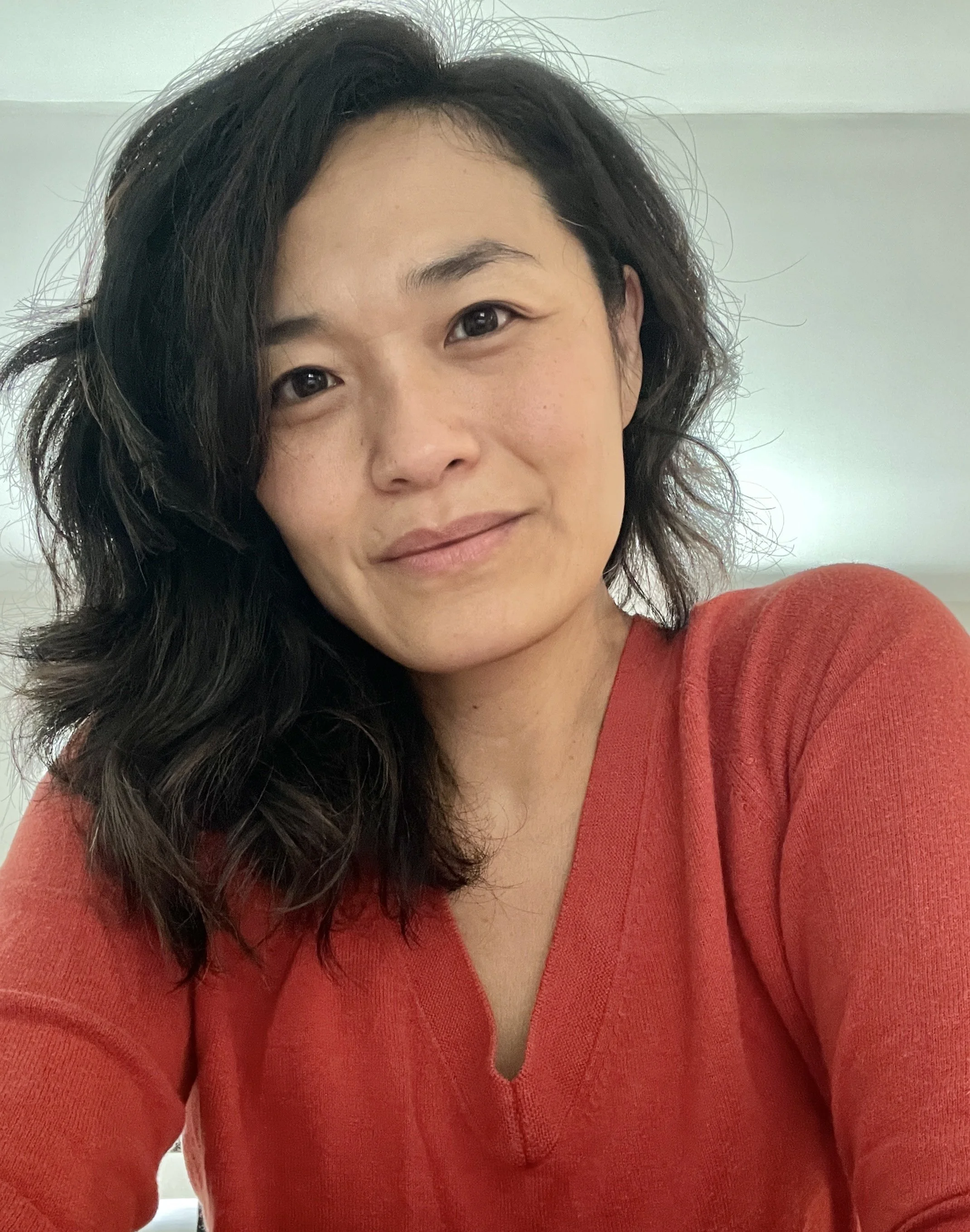
Molly Gaudry, author of Fit Into Me
A Conversation with Molly Gaudry
This interview has been edited for clarity and length.
The Tea House Woman
Amanda: The tea house woman has traveled through all three of your books — from bride to widow to this complicated new chapter. How has your relationship with her changed over time?
Molly: She goes back further than people might realize. Before the tea house woman, there was a junior high teacher in a chapbook — a character haunted by a missing student she failed to notice. I eventually softened her into a kindergarten teacher, someone more nurturing, singing songs to little kids. Somewhere along the way, she became the tea house woman.
In the first book she was minor — I didn't give her much thought. In the second, she's more present, but she's still an enigma; the narrator is obsessed with her but never really has a relationship with her. The narrator ends up fixating on the dead husband instead, and then on Sam, the tea house woman's father. So in Fit Into Me, it felt important to finally spend time with her directly — to bring her into focus. She was a bride, then a widow, and I was writing this book through most of my thirties, a time when I was deeply questioning what I wanted my own life to look like. She gave me a place to work through that.
Amanda: Would you say she feels like a separate person, or more like a parallel self?
Molly: Both, I think. The ghost character in the book — the one desperate for connection, whose hand passes right through everything she tries to hold — that was an analog for my brain injury experience. The tea house woman carried something different: the question of what it means to choose writing over everything else. That's a selfish choice. I can say that plainly, even if it's not in the book. But I made my peace with it while writing her.
Brain Injury and Language
Amanda: You had to relearn to read and write after your concussion. You write about it with a kind of equanimity, but it must have been devastating — to be a writer who couldn't read. Did it fracture your sense of who you were?
Molly: It was a massive existential crisis. The threat of not being able to finish my PhD was real. The threat of not being able to read, or potentially write, ever again — that was real. What ultimately emerged from it was a kind of clarity: by any means necessary, I was going to do whatever I could to hold on to this. It became the most important thing in my life.
Amanda: Did the experience change what you think writing is for?
Molly: I think I always knew I wanted to be a writer, but I felt like a fraud. The imposter syndrome was intense. What the brain injury did was strip away the ambivalence. The recovery, the medical debt, all of it — it was all in service of reclaiming something I hadn't fully understood I couldn't live without. That clarified things completely. The fight made it real
Adoption and Identity
Amanda: The speculative essay imagining your Korean brother arriving with news of your father's death is one of the book's most striking moments. What drew you to imagination as a way into that part of your identity?
Molly: I conflate two visits in that essay — the summer of 1999 and the summer of 2000. I haven't spoken to anyone from that family since I left in 2000. I think many adoptees want to find their biological family, want to know something, and then want to be embraced. Mine did embrace me. My stepmother especially — she was there every day, she had stopped working to be home, she was doing everything she could for me. And the more she did, the worse I felt. She wasn't my mom. She was their mom, and I felt like I was getting in the way.
Amanda: Did you come to any conclusions about your biological mother?
Molly: There's a theory I arrived at that I find easy and comforting, even though I know it's not necessarily true. My aunt — the one who always stayed in contact, who brought me to the adoption agency, who came to meet us when my mother and I returned to Korea when I was a child, who looks like me, who gets emotional every time she sees me — it's easy to believe she's the one. She became a nun. I was given up in 1983. I think it would have been a real problem for an unwed single mother in Korea then, whereas for my father, who they acknowledged openly, it simply wasn't the same kind of shame. The theory is convenient. But it's nice to think.
Amanda: You arrive at it in the book with such hard-won quietness.
Molly: It simplifies the emotional questioning. I know it's not necessarily the truth. But it lets me move on
Writing Process
Amanda: Your word-bank method — pulling words from source texts, using them as prompts — seems almost ritualistic. How did it come about?
Molly: It was an act of desperation. I had my first book deal without a finished book, the deadline was approaching, and I couldn't do it. I don't even know where the idea came from — I think I must have encountered a word-bank prompt somewhere in my writing life and it lodged there. So I made the lists and just wrote. There were bad pages, unusable pages, and I knew it, and it didn't matter. I could blame the prompts for the bad writing. That freed me.
Amanda: Do you think it could work for other writers?
Molly: I really do. Because if I say "candle" and "tree," we all go immediately to our candle and our tree. Whatever comes out on the page was already in us — it just gets excavated faster.
Amanda: And revision — you described reading through the entire manuscript, marking everything, fixing it, then starting over from page one. Doing that multiple times a day.
Molly: By the time I'm done with several months of revision, I know it by heart. The language is right, every sentence has been worked over. I also lean heavily on trusted readers throughout. One friend was reading pages in the final stages right alongside me, almost in real time.
Amanda: That sounds a little like what George Saunders describes in A Swim in a Pond in the Rain — read until you find something you don't like, fix it, keep going until there's nothing left you'd change.
Molly: I love that. Yes. That's essentially it.
Rose Metal Press
Amanda: Rose Metal Press feels like such a natural home for this book. How did you find your way to them?
Molly: We've known of each other for a long time. Back in 2009 I submitted a fiction chapbook to one of their contests and it was a finalist. I've been reading their books ever since. When their hybrid genre open contest came around, this book had already been contracted with other publishers without making it into print. It felt like a last, considered move — this is where it belongs, or it goes in a drawer.
Amanda: And how was the editing process?
Molly: They asked for closure — a lot of it. I had left many threads deliberately open, and they wanted more resolution. We negotiated. Some things I closed, some things I kept unknown. It wasn't a series of edicts; it was a real conversation. And it moved quickly — when your brain is on it, you need to just dive in.
Amanda: How do they compare to your earlier publishers on the marketing side?
Molly: They're hustling in a way I haven't experienced before. My first two books were with much smaller presses — I didn't have this kind of support. Rose Metal is getting books into stores, organizing readings, genuinely professional throughout. It's a different experience.
Amanda: You've been patient with this book. It sounds like a long game.
Molly: I think it's just knowing what's out there, knowing who's out there, and understanding what they do. You hear stories of writers finally getting accepted by a magazine they've been submitting to for twenty years. It's that. Perseverance, but also paying attention.
Amanda: THanks. That’s a great closing note.