
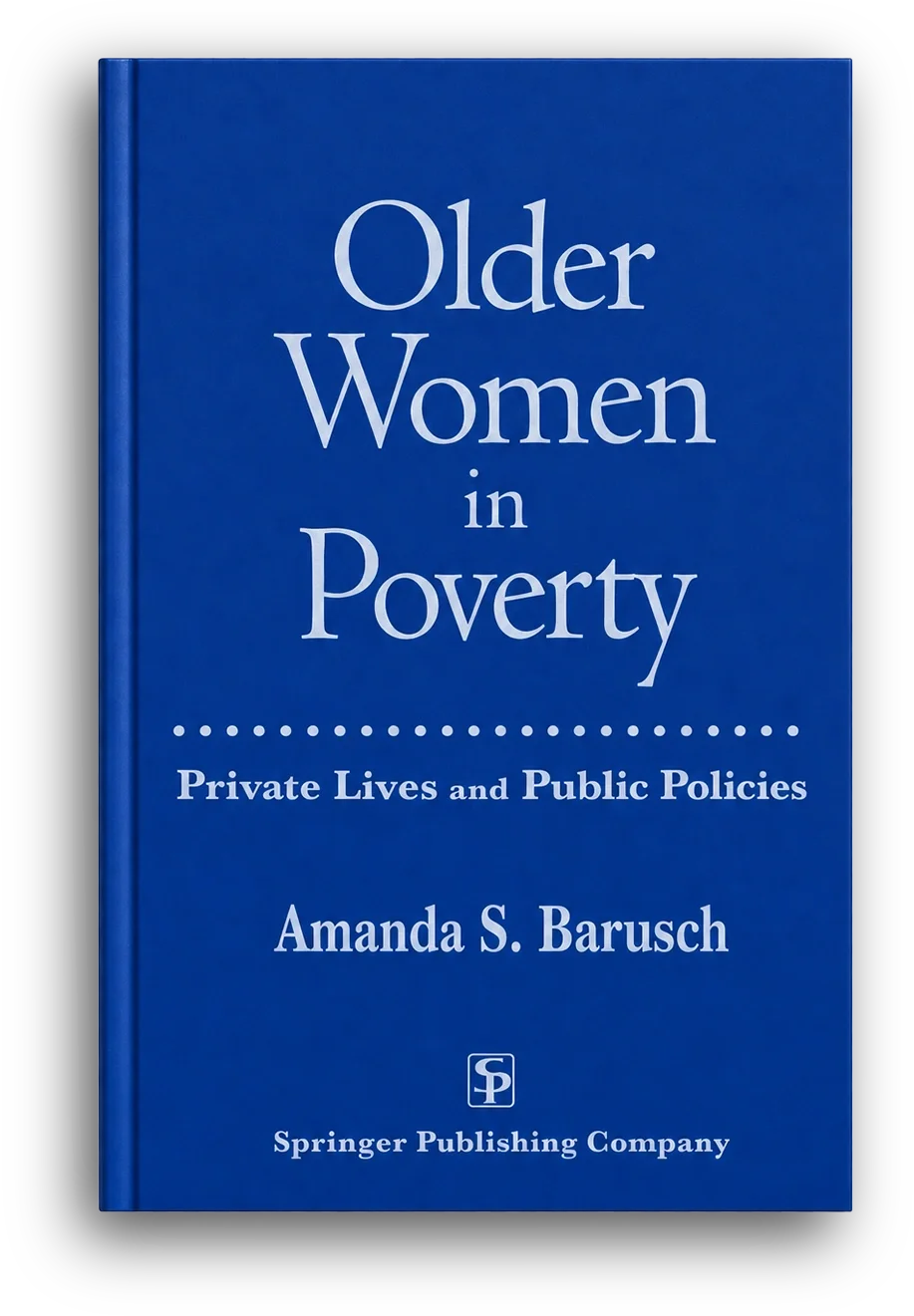
Older Women in Poverty
Private Lives and Public Policies
First published in 1994, Older Women in Poverty remains a powerful examination of the structural inequalities that place women at greater risk of economic insecurity in later life.
Drawing on the stories of low-income older women, Amanda Barusch explores the lived realities behind poverty statistics, revealing how caregiving, unequal earnings, widowhood, and public policy intersect across a lifetime.
Why This Book Matters

Older women are disproportionately vulnerable to poverty, not because they failed to plan, but because many spent their lives navigating systems that failed them.
Lower lifetime earnings, unpaid caregiving, interrupted careers, widowhood, rising housing costs, and inadequate retirement protections all compound over time. What may appear to be an individual financial struggle is often the cumulative result of structural inequality.
More than thirty years after its publication, the questions at the heart of this book remain deeply relevant.
Springer Pub Co • 2008 • Hardcover
About the Book
Why are older women disproportionately vulnerable to poverty?
In Older Women in Poverty, Amanda Barusch examines this question through the lived experiences of low-income older women whose stories reveal the human realities behind economic statistics. Through narrative research, she brings individual lives into conversation with broader systems of inequality.
Drawing on interviews with sixty-two women, including seven in-depth life histories, Barusch explores how caregiving, interrupted employment, unequal wages, widowhood, and public policy shape economic security in later life. These stories reveal how poverty in old age is rarely the result of individual failure, but more often the cumulative consequence of structural disadvantage.
First published in 1994, this groundbreaking study challenged persistent myths about poverty and aging by centering women’s voices and lived experience.
More than three decades later, the book remains a powerful and deeply humane examination of economic inequality, resilience, and the policies that continue to shape women’s lives as they age.
Endorsements

Inside the Book
Seven women. Seven lives. One structural truth.
Chapter 1: Seven Life Stories
“What is life?
An illusion, a shadow, a story.”
–Pedro Calderon de la Barca, 1600-1681
THE POWER OF THE LIFE STORY lies in its capacity to reveal general truths without obscuring individual uniqueness. Stories reveal the human dimension of broad social trends discussed earlier and the personal consequences of policy events described later in this book.
This chapter offers the life stories of seven women. They were chosen to illustrate themes and observations that emerged from the interviews. Although most of those selected are typical, either of the group or of similarly situated women, two—Sylvia Johnson and Sandra Barringer—are included because of their distinctive life stories. (See Appendix B for a general description of the 62 women interviewed.)
Each life story includes …
Chapter 1: Seven Life Stories
“What is life?
An illusion, a shadow, a story.”
–Pedro Calderon de la Barca, 1600-1681
THE POWER OF THE LIFE STORY lies in its capacity to reveal general truths without obscuring individual uniqueness. Stories reveal the human dimension of broad social trends discussed earlier and the personal consequences of policy events described later in this book.
This chapter offers the life stories of seven women. They were chosen to illustrate themes and observations that emerged from the interviews. Although most of those selected are typical, either of the group or of similarly situated women, two—Sylvia Johnson and Sandra Barringer—are included because of their distinctive life stories. (See Appendix B for a general description of the 62 women interviewed.)
Each life story includes a brief description of the respondent and her surroundings, notes regarding the interview process when appropriate, and a closing discussion of the unique and common aspects of the experiences described. (Note: Although most respondents gave permission—even urged us—to use their names, I have chosen to protect their privacy by changing names of people and housing units throughout the text.
APRIL JEFFERSON-TUSCALOOSA, ALABAMA
April Jefferson lives in a house that she and her six sons built 30 to 40 years ago. The house is small but solid, and she has a large garden in the lot next door. Inside was very clean, with family photos, flowers, and plants everywhere. April is a black woman about 5 feet tall, with salt-and-pepper gray hair. She was wearing khaki pants and a white cotton blouse with terry-cloth house slippers on her feet.
April was born in Tuscaloosa in 1917 and has lived there all her life. Her mother is 89 years old, living in a nursing home. April’s mother raised seven kids alone. Their father “left her with no how.” To ease her mother’s load, April was sent to live with her grandmother. April left school when her grandmother’s husband died “to help take care of the rest of the kids.”
When she was 15 years old, April got married. They had six sons. Then her husband went to prison for 6 years. When he came back, “he didn’t want to do nothin’ but jump on me and beat me up all the time. And, see, the kids had gotten large enough then to tell him, ‘No, you’re not gonna hit mama … you better either leave … now or get ready for us to beat you up or kill you .…’ So he choosed to leave.”
April went back to school after her husband went to prison and her kids were in school. She started night school, planning to be a nurse, and made it to the 11th grade. Then she got sick, and “the doctor told me I would have to stop going to school because it was too much on me goin’ to school and workin’ too ... the teacher told me, he said, ‘Miss Jefferson, you were doing too well to stop.’ I said, ‘Yeah, but I’m gonna have to. The doctor said I might have a stroke.’ And I would rather stop than to have a stroke.”
Quitting school, April worked at domestic jobs to support her family. Sometimes she would work three jobs, “doin’ house cleanin’ and washin’ and ironin’.” The last job she had lasted for 45 years.
While April was working an old lady who lived nearby would look out for her six boys. The boys did the housework at home, “and if they hadn’t did it and they saw me when I got off the bus up there at that store they would get to workin’ …. Because they know you aren’t gonna mess with her.”
April’s former employer, Mrs. Wilson, is a white woman. April says she does not “down white peoples” because the ones she has worked for have always been good to her. Mrs. Wilson helped April and her sons purchase the building materials for their house. When April was sick Mrs. Wilson sent her sister by with bags of groceries. When she found out that April did not have health insurance she paid her Blue Cross premiums. Mrs. Wilson has entered a nursing home, but her niece is still paying the premiums, using funds from the estate.
April told of her employer’s generosity:
… the lady that I was workin’ for the 45 years, she was the sweetest thing I ever worked for in my life.... She said, “well who all are helpin’ you to support those kids?” I said, “Nobody, I’m just having to work....” “And she said, “Well, we’ll have to do something about that ….” So the next year we went down ... she put every one of ’em up six pants, six underwear and shirts and ... she’d get em a rain coat, a pair of tennis shoes …. And they would be so happy …. And that’s the reason why I stick by her today.
April has stuck by Mrs. Wilson. She visits twice a week, and picks up her clothes and washes them at her house. But there are limits to the personal patronage that has supported April and her boys. When “something happens to” April’s former employer, the niece will probably stop paying insurance premiums.
April’s oldest son died in California a few weeks before the interview. She spoke of continued grief and affection for her first-born. “The one that passed here, the other week, he told me, he said, ‘You know what I was thinking in December? ... You worked very, very hard to take care of us …. But you know what? You did a darned good job … you made good mens out of all of us.’ “Of her grief, April said, “one called the other day and asked me how I was doing. I said, ‘some days is good days and some days is bad days,’ because you don’t get over your family right away. It takes time, you know.”
April is satisfied with the way her boys turned out: “They’re nice boys. They try to take care of their families; and if I need ’em I call ’em.” Their families include 16 grandchildren and several great-grandchildren. April’s grandson was beaten up the year before in California. “Somebody just beat him up; we thought we was gonna lose him.” Although her sons are willing to help her, April cites this incident as an example of the reason she does not want to accept their help. They have troubles of their own.
With an annual income of $5,268 from social security, April is below the official poverty threshold. But she does not consider herself poor, saying, “As long as you can help yourself, I don’t think you’re poor, do you?” She compares her situation favorably to that of her parents. “... like I told ’em, it’s [social security] a blessin’ …. I remember when my parents were comin’ on, they didn’t have anything. They didn’t get no check of no kind, so we just had to live the best we could.” April attributes poverty among older women to, “the way they live … they don’t take care of themselves and they don’t do the things they’re supposed to.”
April describes herself as someone who keeps striving. “I keep ... trying to do for myself; and if I can do somethin’ for somebody else, I get up and do it.” She loves “doing for others”; “I just love people. And I get along with people …,” she says. April would like to volunteer to help older people, “there’s people that’s older than I am, you know.”
Religion is central to her life, and April is an active member of the Peach Grove Baptist Church. She has been president of the choir for 32 years and serves as president of the Pastor’s Aid Board and vice-president of the Missionary Society. April reported that when a woman said to her, “Well you always trusted in God, didn’t you?’ I said, ‘Who else did I have to trust in? ... I just enjoy workin’ for the Lord.’ “
Discussion
In many ways, April is like many of the black women we interviewed in Alabama: she did not finish school; she raised her children alone; she worked as a domestic helper; and religion is important to her. Her inclination to distinguish herself from both poor people and old people is also common, and her experience of spouse abuse is not unusual. Finally, her profound desire to help those less fortunate is shared with many of those interviewed.
Her close relationship with one employer, and the benefits she continues to receive are unique. Particularly noteworthy is her employer’s willingness to pay for social security coverage. Although domestic workers have been included in the Social Security program since the 1950s, many employers continue to neglect their responsibilities in this regard (see chapter 9).
April’s views on race and discrimination are typical of most women of color we interviewed. When asked whether white women were different from black women she said, “I don’t think they are, do you? I think we all just … uh …. The only thing wrong with us, we’re just different colors.” When asked whether being black has made it easier or more difficult for her to get by, she answered, “No, I don’t [think being black has made a difference] ... because white peoples has always been good to me … and when we die and leave this world … we’re goin’ to the same heaven! So what difference will it make? So we just want to treat everybody right down here.”
Book Details
Author – Amanda Smith Barusch
Title – Older Women in Poverty: Private Lives and Public Policies
Publisher – Springer Pub Co
Publication Date – January 1, 1994
Pages – 228
Formats – Hardcover
ISBN-10 – 0826179606
ISBN-13 – 978-0826179609
Ideal for Readers in – Gerontology, Social Work, Social Policy, Women’s Studies, and Sociology
This title is now difficult to obtain through standard retail channels, but may be available through academic libraries, interlibrary loan, or specialty booksellers.

Related Scholarship
Recent writings connected to the themes of “Older Women in Poverty.”





Continue the Conversation
The challenges explored in “Older Women in Poverty” have not disappeared. They continue to shape public conversations about caregiving, retirement, housing, and economic justice.
“All women, regardless of race, face a greater risk of poverty in their later years than elderly men, chiefly as a result of social biases and the failure of public policy.”
Learn a step-by-step approach to narrative analysis, blending personal reflection with literary theory for richer, more insightful research.