

Press Kit
Aging Angry
Everything you need to research your story on Amanda Barusch’s book, Aging Angry: Making Peace with Rage.
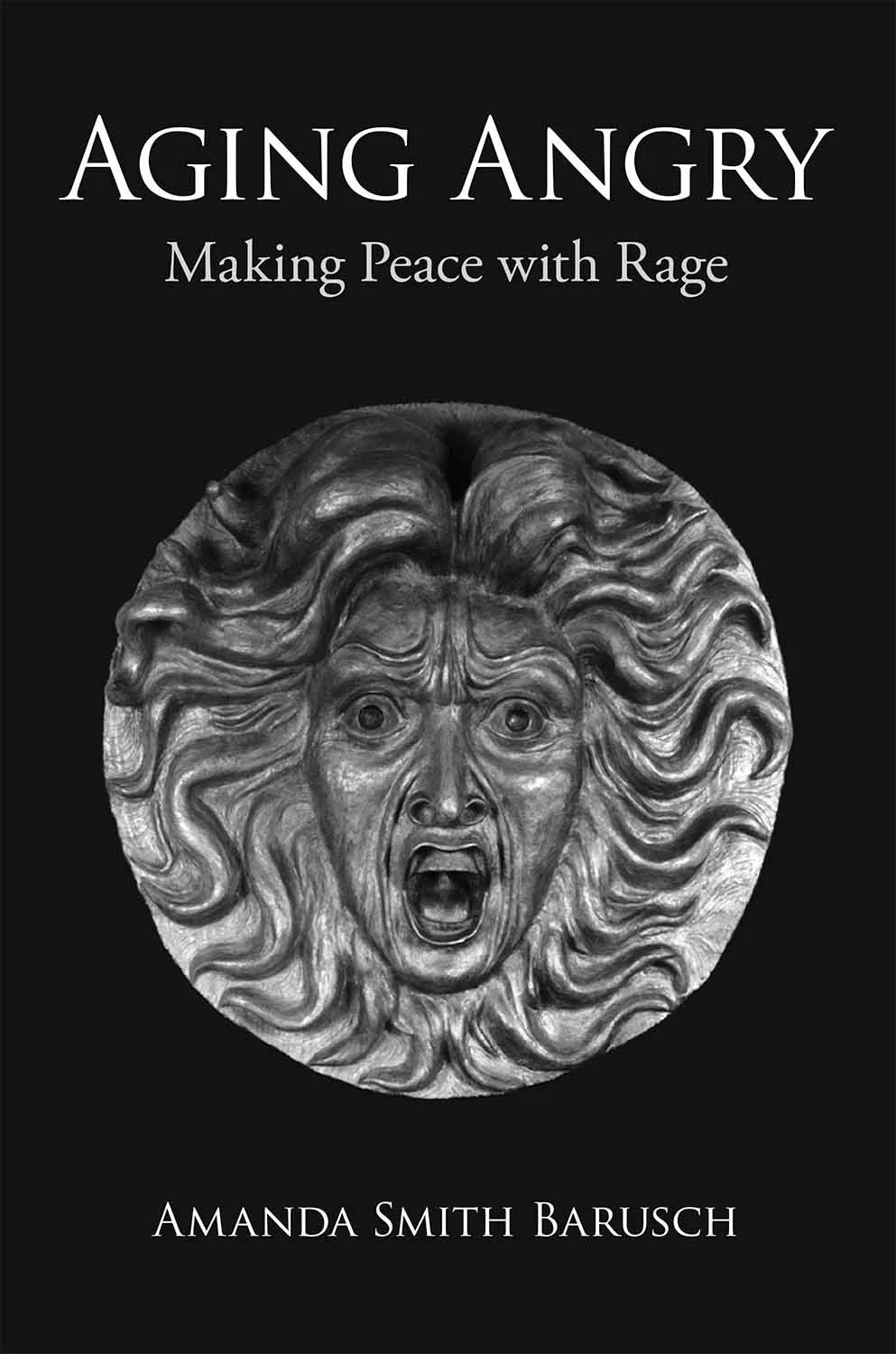
Book Cover Images
View and download the official Book Covers for Aging Angry. Files are available as PNG and JPG.
Aging Angry


Descriptions
View four Descriptions of Aging Angry at varying lengths: Log Line, Pitch, Brief Description, and Long Description.
Aging Angry
Log Line
(29 words)
Have you ever wondered why you get angry all the time? Ever worried that your anger was out of control? Do you freeze when people around you are angry?
Pitch
(63 words)
Anger can be frightening, even dangerous - so much so that it's easy to forget that anger can provide energy and direction for much-needed change. Older adults have a lot to be angry about. Aging Angry tells their stories and draws from a wealth of literary and academic sources to offer a new understanding of anger that is especially relevant to these angry times.
Brief Description
(82 words)
Fear of anger can ultimately be as destructive as expressed rage, fomenting social isolation, injustice, and misunderstanding. In rich and insightful prose, Aging Angry draws upon the experiences of hundreds of older adults and a wealth of literary and academic sources to empower readers with a new understanding of anger’s sources, dynamics, and possibilities. The book unearths the deeper meaning of these angry times and urges readers to take anger seriously; to harness its energy and wisdom for personal and social change.
Standard Description
(148 words)
Aging Angry introduces a new perspective on anger in later life. It draws upon the author’s own experiences of anger, both in the workplace and in the family, as well as interviews and surveys with hundreds of older adults. The book offers:
Fascinating interviews with older adults about their experiences and understandings of anger
A wealth of academic sources and a dozen expert interviews
State-of-the-art research on the physiology of emotions
In depth treatment of ageism and the injustices and microaggressions it engenders
Wide-ranging consideration of how anger is expressed in English and other languages
A history of anger and revenge
Discussion of gender differences and similarities
Exploration of the intersection between race and late life anger
Lessons on anger and love
In depth consideration of late life mass murderers
A critique of anger management programs
Tools for turning towards anger and making peace (and change) with rage
Excerpt
View an Excerpt from Aging Angry (taken from the Preface: Who’s Angry Now?).
Aging Angry
Preface: Who’s Angry Now?
Old age should burn and rage at close of day.
(Dylan Thomas, 1947)[1]
We were all on our best behavior for the first faculty meeting of that fall. The beginning of a new school year is always exciting and this time we had a new dean to welcome. Dressed for success, we jockeyed for position at the huge rectangular conference table. I stationed myself mid-table, behind a fresh clean notebook and a cup of herbal tea. The cast of characters had grown larger and more diverse during my 34 years on the faculty. Looking at my colleagues, I felt a surge of pride. I had chaired the committees that hired most of these bright young faculty members. I smiled as I watched the usual suspects, armed with laptops, tablets, and phones, huddle at the head of the table as close as they could get to the seat reserved for our new dean, almost as if some of his power might rub off on the
The man himself strode in wearing a well-tailored suit and a brisk air of authority. Following introductions, he launched into his plan to establish new standards for publications— standards that would apply to all faculty.
“But not if you’re, like Amanda, in the twilight of your career.”
All eyes shifted to me. I sat up straighter, cheeks burning, heart racing. I shrugged and gave a sheepish grin while the dean went on to detail his exciting new agenda.
“The twilight of your career.” Did he just say I was old? At 62, I liked to think I had a few good years left. It was almost funny; just a tasteless joke. Or could it be a coded threat? My stomach clenched. Did he think I was senile? Did he think I would go quietly? If so, he had a lot to learn.
So did I.
A full professor with tenure, I had researched and taught about aging for four decades, but the dean’s remark was my first experience of overt ageism. It left me feeling threatened and confused. I had already experienced my share of ageist microaggressions and had even learned to appreciate the cloak of invisibility that descends upon older women. But this was different. This was at my university. This was only the beginning.
In the weeks that followed, colleagues bustled into my office one by one and carefully closed the door. “You know, he’s still making that joke about your twilight years.” “Why is he singling you out?” “You aren’t the oldest one here.” I had no idea why the dean was targeting me; why he kept repeating that phrase.
Sure, there was “dead wood” on the faculty and I knew the administration expected the new dean to root it out. There’s dead wood in many academic settings: teachers who refuse to do research, researchers who can’t teach, tenured professors who never show up for meetings, people who use incompetence to avoid work assignments. In my days as an administrator, I had attempted to rejuvenate or remove some deadwood myself.
Could I be dead wood? I directed the largest program in the college, engaged in research, mentored students, wrote books and articles. I saw myself as productive, competent, and (for the most part) well-liked. I certainly had no intention of ending my career. But, in the following weeks, the dean made it increasingly clear that he wanted me gone.
A pattern developed. In meetings, our new leader ridiculed my suggestions and ignored my accomplishments. In private, he complimented me on my appearance. This combination of dismissal and objectification created a puzzling discordance. Meanwhile, staff who worked under me were transferred to other units. Paperwork and administrative demands consumed more and more of my time. The job I loved was replaced by tasks that were dull or impossible or both. Colleagues sympathized but were in no position to help lest they too become targets. The frustration spilled over into my personal life as I found myself snapping at my husband and waking at 3am to ruminate over my mistakes. Finally, I had to admit that I wasn’t aging well, I was aging angry.
And that is how this book was born.
One day, Margaret Morganroth Gullette sent an email to members of the North American Network of Aging Studies reporting that growing numbers of older faculty members with tenure were being pushed out of their positions. They couldn’t be fired, but administrators could make their lives miserable by changing their job assignments and fostering a culture that was hostile to older adults.
Partly, it’s about the money. Cost-conscious administrators figure they can save by trading a highly paid older adult for a less expensive novice. Also, at least in academic settings, an untenured faculty member is likely to be more malleable—less confrontive—than someone who enjoys the job security conferred by tenure.
In 2019, the year I retired, over 15,000 older workers filed age discrimination complaints with the federal Equal Employment Opportunity Commission (EEOC), most related to discriminatory discharge and age-based harassment.[2] That’s just the tip of the iceberg. It doesn’t include state-level data and, apart from that, most cases are never reported. A more accurate measure comes from a 2017 survey conducted by AARP which found 61 percent of older adults reported having seen or experienced age-based discrimination in the workplace.[3]
Age alone is no reason to push a person out of a job. During the 20th century the rate of illness and disability among older adults declined steadily as longevity rose. As a result, millions of Americans are as capable as ever in our 60s, 70s, and (for the lucky ones) even in our 80s.[4] We can certainly do the job.
But, despite our best efforts, we can’t prevent age-related changes in our appearance. While our minds and bodies may be perfectly healthy, our faces slowly collapse into wrinkles, our hair steadily turns grey, and our profiles become . . . well . . . ample. These signals lead others to see us through the lens of their own fear of aging. In a process known as “social aging,” their responses tell us repeatedly that we are unattractive, incompetent, irrelevant.
Most older adults are unprepared for the assaults on our dignity that wear us down and erode our confidence. They make us angry. Sometimes, we displace that anger towards those we love. Sometimes, we direct it back towards ourselves in fits of self-loathing that can increase our risk of suicide. Some of us, lost in bouts of impotent rage, commit murder or mayhem. Still others serve as role models, channeling their anger into efforts that improve the world.
Graduation day is one of the real delights of academic life. At our university, it was invariably sunny and hot. I dressed lightly under my heavy regalia and paraded across campus smiling at parents and their robed graduates. That year, my usual joy was tinged with sadness. It would be my last graduation.
After the final set of handshakes and hugs, I went to my near-empty office. The plants and books were all gone; the recycling bin full of old reprints. I abandoned the award plaques: “Teacher of the Year.” “Dean’s Award for Research.” “Leadership Award.” I did save the thank you notes from students. Those, along with their silly gag gifts, would go home with me. I refused all offers of help, couldn’t stand the pity in my colleagues’ eyes. Muttering mantras of strength and resilience, I borrowed a hand cart and hauled boxes out to my car.
A treasured glass plate still sat in the middle of the table where my students and I used to meet. Made of clear glass with tiny bubbles, it was square with a perfect sprig of lavender embedded in its center and a beautiful navy blue border. Our long-dead family dog (a lab) used to retrieve smooth stones and I kept her collection on the plate. Students liked to handle the cool rocks while we talked. It seemed to help them stay calm and centered.
That plate was the last thing I packed. On my way out, I picked it up from the table, slipped the stones into a paper bag, and set it carefully into the top box on the cart. When I stopped at the curb, that box slid ever-so-slowly-and-inevitably to the ground, spilling the plate onto the asphalt. It shattered. Of course. Hot tears filled my eyes as I clenched my fists and swore like a sailor. Someone offered help, but I shook my head.
It was up to me to pick up the pieces.
This book grew out of that process. I began by asking other people about their experiences of anger. Then I conducted in-depth interviews and developed an online survey that would be completed by hundreds of older adults. I talked to experts. I read. I observed. I thought a lot.
The lessons I gleaned while assembling these pages deepened my understanding of both anger and age. I came to recognize the tight weave of culture, history, and identity that shapes our experience and expression of anger. I learned about the enormous contribution neuroscience has made to our understanding of human emotions; and yet, how tightly we cling to antiquated notions about both anger and aging. I learned how anger norms vary across time and cultures and even among families. I came to see how the expression of anger can be used to control others and how its suppression can threaten both personal and public well-being. I began to understand how age, gender, and race interact to shape our experiences of anger. Most importantly, I learned that in later life, when our emotional intelligence is its peak, we can tap into the power and wisdom of anger to fuel the changes that we and our world so desperately need.
A Note on Memory:
Each time we touch a memory we reshape it according to our mood, our attitudes, and our ongoing discovery of new truths. This certainly applies to the personal recollections I offer in this book. While I have checked basic facts with others who were present, my own perspective no doubt colors the narratives you will find in these pages. Those looking at these events from other points of view might describe them quite differently.
1. Excerpt from “Do Not Go Gentle Into That Good Night” by Dylan Thomas, from THE POEMS OF DYLAN THOMAS, copyright ©1952 by Dylan Thomas. Reprinted by permission of New Directions Publishing Corp and The Dylan Thomas Trust.
2. See:
https://www.eeoc.gov/newsroom/eeoc-releases-fiscal-year-2019-enforcement-and-litigation-data
https://www.zippia.com/advice/age-discrimination-statistics/
3. Perron, Rebecca. The Value of Experience: AARP Multicultural Work and Jobs Study. Washington, DC: AARP Research, July 2018. https://doi.org/10.26419/res.00177.000
4. See: Cutler, David & David Wise (Eds) (2009). Health at Older Ages: The Causes and Consequences of Declining Disability. Chicago: University of Chicago Press.
One-Sheet
View the One-Sheet for Aging Angry. This includes the book cover, a short description, selling points, endorsements & reviews, contact information, publicity, product details (title, author, category, ISBN, formats, trim size, pages, price, publication date, available from, and contact), as well as a short author bio.
Aging Angry
Title: Aging Angry: Making Peace With Rage
Author: Amanda Barusch
Category: Aging, Parenting & Relationships
ISBN: 9780197584644
Formats: Hardback
Trim size: 6 1/8 x 9 1/4 inches
Pages: 240 Pages | 10 b/w illustrations
Price: $90
Publication date: January 2024
Available from: Oxford University Press
Contact: amanda@amandabarusch.com
Aging Angry
Making Peace with Rage
Fear of anger can ultimately be as destructive as expressed rage, fomenting social isolation, injustice, and misunderstanding. In rich and insightful prose, Aging Angry draws upon the experiences of hundreds of older adults and a wealth of literary and academic sources to empower readers with a new understanding of anger’s sources, dynamics, and possibilities. The book unearths the deeper meaning of these angry times and urges readers to take anger seriously; to harness its energy and wisdom for personal and social change.
Selling Points
Written by a distinguished gerontologist
Based on original research with hundreds of older adults
Debunks common myths about aging and anger
Endorsements
“Barusch’s fascinating interviews with ‘grumpy, cantankerous, and obstreperous elders’ deepen our interest in using this primary emotion effectively to heal our nations of the common curse of ageism and improve the world.”
—Margaret Morganroth Gullette, author of Ending Ageism, or How Not to Shoot Old People
“Superbly researched with stories interwoven to amplify our understanding of anger through multiple lenses: historical, cultural, psychological, and philosophical.
—Constance Corley, Emeritus Professor, Cal State Los Angeles Source
Contact
Amanda Barusch
amanda@amandabarusch.com
+1-385-429-0104

About the Author
An aficionado of narrative, Amanda strives to harness the power of stories to explore deep truths about the human experience. She received her Ph.D. in social welfare at the University of California, Berkeley, and her MFA at the University of Utah. She now teaches writing in various universities and correctional facilities.
Table of Contents
View the Table of Contents (TOC) for Aging Angry.
Aging Angry
Preface: Who’s Angry Now?
Chapter 1 Aging While Angry
What’s Anger?
Simple Truths vs. Scientific Proofs
Death by a Thousand Cuts
They’re Just Going to Die Anyway
Ageism at Work
Family Matters
Mad as Hell
Don’t Put a Lid on It
Anger Unbound
Chapter 2 Speaking of Anger
Telling It Slant
I Just Exploded
Disgusting Idioms
Metaphors from Other Lands
Hold Your Tongue
Cantankerous, Crotchety, and Grumpy
Chapter 3 Anger through the Ages
Contemplating Aristotle
If a Thing Is Bad
Vengeance Is Mine
Was Jesus Angry?
Is Anger a Sin?
My Nightmare
Chapter 4 Angry Bodies
Inside the Lizard Brain
The Survival Circuit
Late Life Variability
Bad for Us or Just Plain Bad?
Context Matters
Chapter 5 Women Cry / Men Rage
Anger Makes You Ugly
Real Men Don’t
I Need Another Happy Pill
A Lot to Be Angry About
Are Men Really More Angry?
A Gender Paradox
Chapter 6 Race & Anger in Later Life
Angry Times in American Streets
Of Life and Time
The Tiresomeness of It All
A Legacy for the Grandchildren
Anger Builds Character
Chapter 7 Elders on Social Media
The Rage Contagion
Cyber Space for Rants
A Duty to Die?
Seniors Trapped in YouTube
Meanwhile, Back in the U.S.A.
The Anger Project Online
Chapter 8 Lessons on Anger & Love
Homes Full of Anger
A Panoply of Family Anger
The Lover’s Quarrel
The Sulk
Serpents’ Teeth
Kick the Dog Syndrome
Chapter 9 Aging, Angry, and Armed to the Teeth
A Very Big Year
Yeah, It Fits
What Was Wrong with This Man?
That Nagging Sense of Unfairness
Rageonomics
Not Again
Beyond Disgruntled
Chapter 10 Taming the Rage
Intermittent Explosive Disorder (IED)
Helping People Manage Anger
Stop Dictating to Us
Destroy That Monster
Sometimes Therapy Works
Time’s Passage
Chapter 11 Embracing the Anger
Chemical Restraint
A Dose of Hope
American Cool
A Word from the Wise
Turning towards Anger
Chapter 12 Changing the World
Anger Constrained?
Great Old Broads and Raging Grannies
Choosing Anger
Striking a Light
Conclusion: The Eye of the Heart
Bibliography
Appendices
Appendix 1 The Anger Project
Appendix 2 The Interview Protocol
Appendix 3 The Internet Survey
Where to Buy
Find out where to buy copies of Aging Angry.
Aging Angry
Aging Angry is published by Oxford University Press. Availability, formats, and pricing are determined by the publisher and booksellers.
For institutional orders, library acquisition, or course adoption, please check Oxford University Press or your preferred academic bookseller.