Finally: A Grandparenting Book for the Rest of Us
It was at 2am and my family was snuggled all warm in our hotel beds on the 6th floor when the alarm went off. A loudspeaker announced an emergency had been reported and instructed us to leave the building immediately and NOT take the elevator. This high-volume announcement repeated every 20 seconds.
It took a while for my husband and me to get our bearings, put on coats and shoes, grab our phones and head down the hall, where our son and his family were lodged. We banged on their door and heard shuffling sounds inside. After what felt like a very long time, our son answered half-asleep with seriously tousled hair. The rest of the family, his wife and two kids, looked at us from their beds.
“Come on, let’s go!” my husband shouted. “We have to get out of here.”
My son and his wife were reluctant. “It’s probably a false alarm.” One of them said.
“It doesn’t matter.” I piped in. “We can’t just stay here.” The announcement seemed to grow louder by the minute.
I took my grandson’s hand and said, “Come on sweetie. Let’s go outside and see what’s happening.” I held his hand tight while we jogged down six flights of stairs in our pajamas. Out on the hotel lawn, we looked up expecting to see flames or smoke, some sign of the emergency. Nope.
That’s when I realized “the kids,” as I still think of the “parent” generation, were right. It was a false alarm.
I watched as my exhausted daughter-in-law stomped down the stairs carrying her 10-month-old daughter. For nothing.
It was all my fault. I had hijacked my grandson and forced his family out into the cold wet night for nothing. In the mulling around that followed while we confirmed the false alarm, I berated myself for failing yet again to be the perfect grandmother.
You know, the one. She’s preternaturally calm and cheerful and above all PATIENT. She always puts others before herself, bakes cookies at the drop of a hat, and still has time to play perfectly safe, educational games with the children. She is never wrong or impetuous. She would never hijack anyone. I was beginning to hate her.
Finding a book for Real Grandmothers
Hoping I wasn’t the only thoroughly flawed grandmother in the room, I set out in search of others. I read books and articles—everything I could get my hands on about grandparenting.
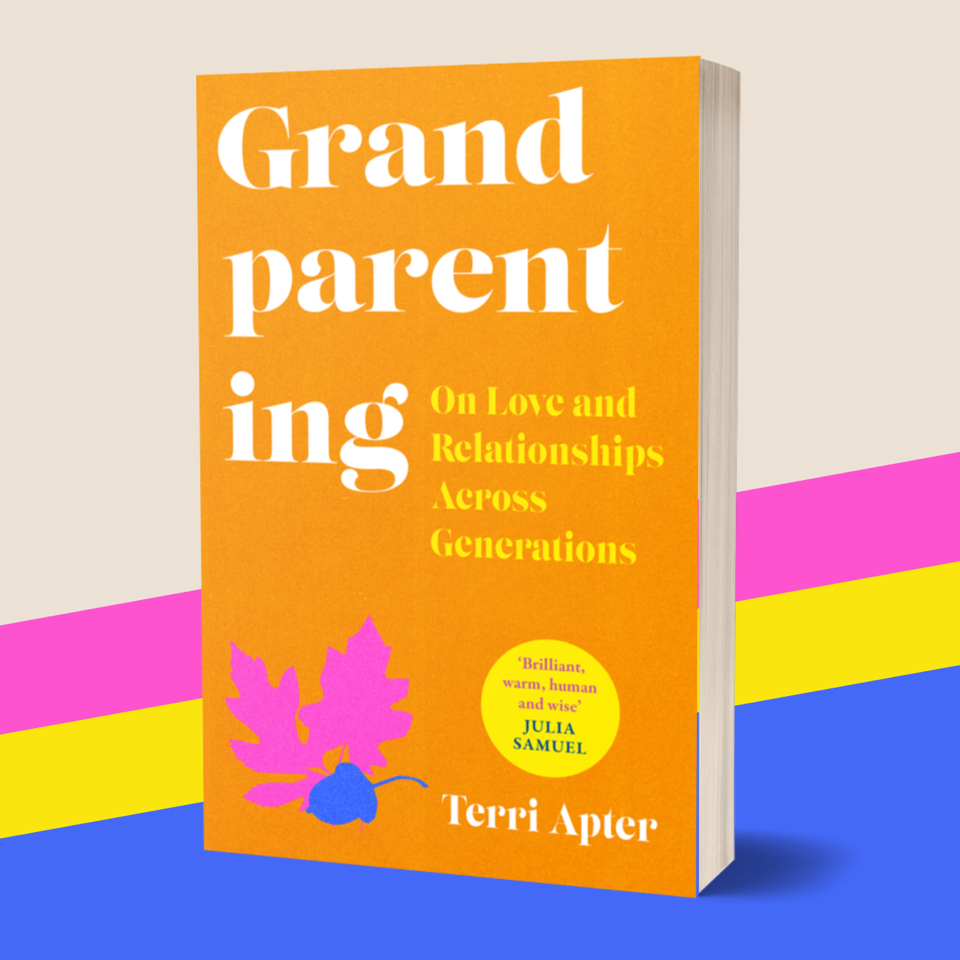
I read celebrity memoirs by (Nanaville, by Anna Quindlan and Becoming Grandma, by Leslie Stahl) I read 101 Things Every Cool Grandmother should know, by Rowan Hayne and a few others that aren’t worth mentioning. Nothing spoke in to my struggles. Just as I was beginning to think I might have to write the book myself, I found Terri Apter’s work, Grandparenting: On love and relationships across generations.
Terri Apter is a psychologist and researcher at Cambridge University who has spent decades studying family relationships through in-depth, qualitative research. Unlike the celebrity memoirs and advice books that populate the grandparenting shelf, Grandparenting draws on Apter's six years of fieldwork with multiple generations of families. She observed them, interviewed them, and returned to them over time - developing what she calls "a register of possible feelings and relationships and patterns" that ring true to the messy, complicated reality of modern family life.
No Easy Answers
What sets this book apart is Apter's refusal to peddle easy answers or create caricatures of the "good grandmother" and the "difficult daughter-in-law." Instead, she introduces practical concepts that help us understand what's actually happening in our family dynamics. Take "border work," for example - the ways we mark and protect our identities and status within the family. When a new mother snaps at her mother-in-law's well-meaning suggestion, she may be engaging in border work, essentially saying "I am the mother now. I have this status." Understanding this doesn't make the snap sting less, but it helps us see it for what it is: not a personal rejection, but a claim to authority that every new parent needs to make.
Apter also tackles the "good behavior syndrome," that exhausting pattern where grandparents (especially paternal grandparents) walk on eggshells around their adult children and in-laws, constantly monitoring their words and actions to avoid causing offense. She acknowledges the real vulnerability here: the daughter-in-law is often the gatekeeper to the grandchildren, and paternal grandmothers, in particular, may feel they don't know where the "pinch points" are - those seemingly neutral topics or behaviors that suddenly reveal themselves as painful or offensive.
But here's what I love most about Apter's approach: she doesn't tell grandparents to simply accept this state of affairs and keep quiet. Instead, she offers strategies for setting boundaries without threatening connection. It's about finding language that acknowledges both autonomy and relationship.
Estrangement and Other Challenges
The book also addresses one of the most painful situations grandparents face: being cut off from their grandchildren entirely. Apter estimates that one in seven grandparents experience this, though the shame and humiliation make many reluctant to discuss it. She explores the different routes to estrangement - sometimes it comes from adult children who were genuinely hurt by their parents' behavior, sometimes from an in-law who fears the grandparent's influence, sometimes from the aftermath of a bitter divorce. She doesn't offer false hope or blame, but she does provide a framework for understanding what's happening and, where possible, finding paths toward reconnection.
Throughout the book, Apter draws important distinctions - between maternal and paternal grandparents, for instance, noting that in Chinese languages don’t have a single word for "grandmother" because these relationships are so fundamentally different. She explores the unique challenges of being the paternal grandmother, always aware that you don't have that "immediate right of access" that comes more naturally on the maternal side.
Perhaps most importantly, Apter's work is grounded in empathy without being blind to manipulation or harmful behavior. She can hold space for understanding someone's deep needs while still calling out when they're using those needs to control others. This nuanced approach feels like sitting with a wise friend who sees all sides of the situation and helps you navigate it with both compassion and clarity.
For those of us navigating the real challenges of grandparenting - the false fire alarms and hijacked grandchildren, the snappy daughter-in-law who's just exhausted and the son who seems oblivious to the family dynamics swirling around him - Apter's book offers something precious: permission to be imperfect, language to understand what's happening, and practical strategies for building and maintaining these crucial relationships across the generations.
Meet Terri Apter
This interview has been edited for clarity and length

Amanda: I'm really interested in the method behind your research. You were deeply engaged with your respondents over a long period of time.
Terri: I started doing qualitative research observing families - mothers and teenage girls - asking them to keep diaries, sometimes observing them in their homes. A lot of those girls are now mothers, and the mothers are veteran grandparents. I'm still in contact with many of them. It's quite a commitment, and I want to honor that. I recruited others too - inviting people to express interest, then determining if they were someone I could meet with, whose family I could observe. The fieldwork took about six years.
Amanda: That depth really came through. One thing I found especially valuable was your use of the concept of "border work." Can you explain its background?
Terri: Border work is a term coined by Barrie Thorne, who was looking at behavior of girls and boys in school playgrounds - how they were constructing and policing gender. I found it useful when studying teenage girls and their mothers, because teens are giving their mothers identity reminders: "I'm not the little girl you think. I've changed. I'm not like you."
With grandparenting, when a woman becomes a new mother and is dealing with either her mother or mother-in-law, she wants to make very clear: I am the mother. I have this status. The grandmother may be unaware and certainly not intending any encroachment, yet the new mother may feel she has to remind these veteran parents that she's the mother now. Her concern is the greatest. Her rights are the greatest.
Amanda: That relates perfectly to a conversation I had with my daughter-in-law, where she reminded me that her primary responsibility was protecting the children.
Terri: The strategies would be to set borders without threatening the other person's status or connection. Everyone has a right to borders, but you don't want to just draw a line between you. You also want to assure them there's a connection. Something like: "I have the final say here, but I really welcome your input. You're a very important part."
Amanda: This connects to what you call the "good behavior syndrome."
Terri: The good behavior syndrome arises when you're super aware of that danger. You know feelings are not precisely what the other person would want them to be, and you don't know exactly where their pinch points are, what kind of border they're going to draw. You think, "I know how much work it's going to be if I don't comply with the rules of politeness, their expectations, so I better keep to those rules." It means you're not relaxed, not saying what you think. You always have to take a beat if you're particularly annoyed. The relationship is more constrained, but at least you don't have to go through that overtime of trying to apologize for what you've done.
Amanda: You mentioned research on differences between paternal and maternal grandparents. Can you sum that up?
Terri: I spoke with Diana Lary, a Chinese scholar who wrote a book on grandmothers in China. She points out that in Chinese languages, there is no single word for maternal grandmother and paternal grandmother. They are seen as so different they need different terms.
Grandmothers tend to be aware that the daughter-in-law is the gatekeeper to the grandchildren. There are cases where the relationship is very close and easy, but more often it's a little uneasy, and you don't exactly know where her pinch points are, what kind of border she's going to draw. Often these paternal grandmothers say, "My son is oblivious to how I'm excluded or how her mother gets preference."
The new mother, tired, stressed, life transformed, is likely to be a bit snappy with her own mother. But they have the roots of repair - they've been through adolescence together. But with the mother-in-law, how are we going to find our way back? What does this really mean? And here's this child that I may be as attached to as to my own child, but I don't have that immediate right of access.
Amanda: You mentioned how many grandparents find themselves banned from seeing their grandchildren. What's your estimate?
Terri: Our best estimate is one in seven, but that's a bit of a guess because a lot of people who are banned don't talk about it. It's shameful, humiliating. They think, "You must think I'm awful if the parents think I'm unfit to see my grandchildren."
There are different routes to this. There will be some adult children who say to their parents, "You really hurt me growing up. I'm not going to have my children deal with that." A lot of times this barrier comes from an in-law - "You're going to poison my children because you have a different belief."
If there's a possibility of conversation, asking "What is it you are worried about? Are there conditions under which I could see them?" Some in-laws will say, "You can see them, but only at my house and in my presence." That can be really hard to accept.
Amanda: I was interested in your thoughts about grandparent rights.
Terri: In the UK and US, there are no automatic rights for grandparents to have access. You can apply to the court for permission to apply for access. If granted, there are usually conditions - a parent has to be there. I think given the enormous connection that so many grandparents have toward their grandchildren, this should be acknowledged in law somehow.
I think there could be a presumptive right for grandparents to visit, even to spend time with them on their own, and a requirement for the parent to make a case for why not.
Amanda: What about your own grandchildren - did they know you were writing this?
Terri: They didn't know initially. They're curious now. They range from seven to fourteen. I'd love to go through the book with my fourteen-year-old grandson and point out sections where I talk about him. Sometimes I’ll blurt out "I love you," and he'll ask, "But why [do you love me]?" I think I could explain in terms of how I looked after him when he was a tot and how engrossed I became in his vision of things.
Amanda: What about your own grandparents - how did they influence your interest in this topic.
Terri: My grandparents were affectionate, but the relationship grew more distant as I grew up. My parents saw them as very old and past it - unsuitable as carers because they wouldn't be able to anticipate danger or keep up with us. They weren't as active, either physically or mentally. They were from a different generation.
Amanda: That's really interesting.
Terri: Maybe that's why my response as a grandparent was so unexpected - I didn't expect to be this involved, this committed.
Amanda: Let's talk about your writing practice and how it interfaces with research.
Terri: I write when I can. I look at my schedule and find when I can sit down and do it. I've learned to accommodate interruptions. I write up observations as soon as I can afterward. I go through transcripts, underline things, highlight them in different colors. As soon as I have some idea about the shape of things, there's internal pressure to put it down, because what I see clearly today can be lost absolutely.
Amanda: Do you wake up at night with insights?
Terri: If I'm thinking about it before I fall asleep, I'll probably get up to write something so I don't forget. If it's in the morning, I can hold on to it for a bit, but it will be high priority to get that down today.
Amanda: How did this book come about?
Terri: The commissioning editor came to me and said she wanted to commission a book about grandparenting. I had been thinking about the issue but hadn't been thinking about writing the book because I thought it was going to be too gray and too cozy. But this was a young woman with two very young children. I thought, if that middle generation thinks this is an interesting topic, perhaps I can go for it. As soon as I started, I saw that my work on generations of love was right there, my work on in-laws was waiting to be used.
Amanda: I loved your ending quote about hoping you're giving grandchildren something that will abide in them.
Terri: You realize your time with them is limited. You want to protect them from everything, and you know you can't. You just hope some of the things you've given them stay with them. Often adults who have suffered trauma, when asked about a safe place, will say "It was with a grandparent. I felt safe there." You hope you're giving them something that will somehow abide in them and be activated when they need it.